Welcome

Welcome to my blog. I will attempt to make it much more than just a pitiful list of the relentlessly mundane minutiae of my daily existence but if you feel that I have failed try to imagine all the stuff that I haven't posted.

Tuesday, 17 February 2015

Who says men can't multitask?

After the incessant rain of yesterday it was a pleasure to continue packing the kiln in clear skied sunshine. Chilly, yes, but no time to worry about fridge cold wadding on my fingers.
I'm taking my time to pack the kiln - many pots are glazed but I'm continuing to glaze as I got - getting the best pack I can with the most appropriate clays, slips and glazes for each part of the packing space. Feeling unseasonally full of energy I decided to do a glaze firing in the gas kiln as well today. Pretty simple really to balance the two - until reduction time when the kiln suddenly became atypically unresponsive. One of the flame failure devices had given up
resulting in frantic repair work to get the burner back on. Finally I was back on track with a slow temperature rise in gentle reduction. Kiln packing continued along with a delivery that needed unpacking and hauling up to my workshop, gas delivery and the last of the rocks dry milling and needing seiving.
I'm typing one handed, holding a glass of excellent Rioja, as I write this. Aching slightly, but feeling nicely chilled and chuffed as I mull over all the things I did today. The firing finished smoothly, with an oxidised soak - cone 10 half down. The front chamber of the kiln is packed, and I'm halfway up the left hand stack in the back chamber. 2 days down, maybe only 1 to go.

Sunday, 8 February 2015

True Grit

Glazing is well underway and I'm preparing the last of the rocks needed for my rock glazes - a coarse pink granite  and a darker microgranite from Cumbria. I've crushed and milled the hardest/most difficult rocks - notably a Cumbrian rhyolite and some of the limestones I have - and these last are pretty easy.
First up I calcine them in my small test kiln - just up to a good red heat - maybe around 800C. It doesn't matter exactly how hot as long as the rocks are red hot right through. Sometimes I have to use a steel mallet to get them into manageable size and they are truly hard! These have been calcined + all the moss/lichen burnt off.

During this process the crystals in the rock expand and contract at different rates making them beautifully crumbly. Next it's the turn of my trusty mortar and pestle, and a good stretch of time.
Repeated crushing and seiving
to get the rocks down to this size grit. They are then dry ball milled for 3 hours or so to get the particles down to dust size, which is probably around 100 - 120 mesh.
Then, blending with other rocks and clays to get my glazes. I'm aiming to finish glazing this coming week, finish splitting wood and still have to grind glazes off the floor of the kiln.

Wednesday, 28 January 2015

New year. New start.

Despite my best intentions the frequency of my posts over the last 6 months has been rather low - not due to any lack of frantic activity at the workshop, but possibly because of my reluctance to take my expensive camera there to record my days amid the dust, damp and disarray. So, I now have a waterproof, shock proof (workshop proof) camera to record my process much better.

Most of my making is now over - managed this year without anything freezing and getting ripped apart by ice - and the next stages are well underway. My shoulder muscles are complaining as I type this, as I'm busy crushing rocks in my steel mortar and pestle down to 3mm grit ready for ball milling. This is a carbon rich limestone - one of the few rocks that I wet mill - drying out on plaster.

The second to last biscuit firing is packed and has spent the day on a very low burner drying out. There are some high carbon bodies inside, my milled sort-of-porcelain, and that difficult secondary kaolin body that needs it taken nice and even and slow to prevent firecracking.


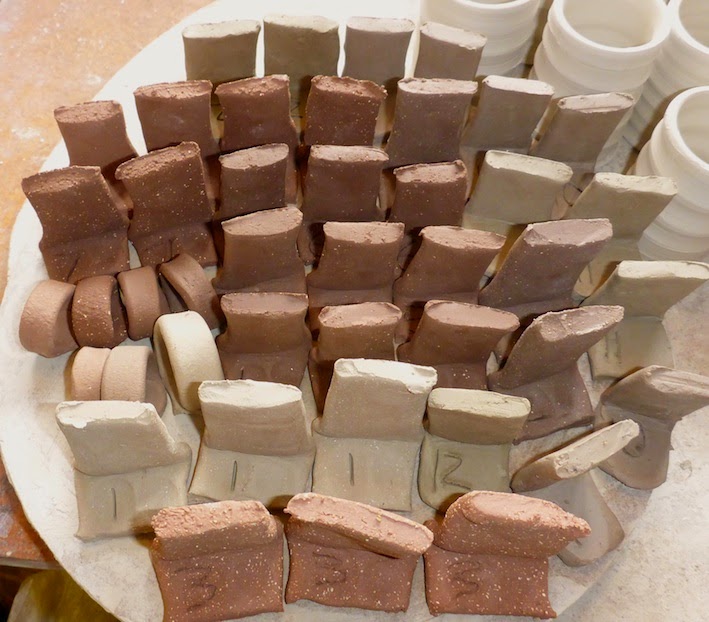
The odd little red/brown shapes are setters to put the side fired pots on in the wood kiln.

And finally, for this post, a selection of clay body tests for the next wood firing. I always put a variety of tests in a firing - new clays and glazes - and this time I have additional tests from 2 research commissions I am undertaking. one of these is the coprolite project, and the other developing darker clay bodies using local British clays.

Friday, 12 December 2014

Talking sh*t

....specifically dinosaur dung....fossilised dinosaur dung. I get regular contact from people who are asking for advice and help developing their own glazes out of found materials, but this has to be the most unusual. I have been commissioned by a conceptual artist, based in The Netherlands to develop a glaze that is based on fossilised dinosaur dung - or coprolite as it is properly known.
This is a sample in cross section, showing the variations, seams and nodules in it. From reading up on it I believe that these represent the animals last few meals, remnants of these remaining in the fossil. Items found in dinosaur coprolites include fossilized bone, teeth, fur, plant stems, seeds, pollen, wood chips, fungus, insects, larvae, dung beetle burrows, fish scales, shells, and glassy marine organism microfossils 30 to 50 microns in size.

 This sample has been weighed and calcined to 1000C, reweighed and is then steeping in concentrated acid. I'm trying to get a better idea of what minerals are actually present in the fossil.
...and here are my first simple melt tests and lineblends - again designed to help me ascertain what potential glaze materials are actually present here. These results should tell me lot, including how hard or easy this project is likely to be. Fingers crossed.

Friday, 14 November 2014

Autumn with a vengeance

Where have the last weeks gone? The last thing I remember is enjoying our long late summer and the wonderful expansive East Anglian September skies, then the clocks went back and now dusk is beginning in the afternoon. It rained heavily all day today and the water butts are full.
As I write this the dark is rising and my feet are icy. It could be somewhat depressing but I find I have a workshop full of pots that are trying to dry and I am well on the way to having my first kiln load. My aim is to make enough pots for two firings in the large kiln, back to back, so that I have a good selection for Ceramic Art London and an exhibition I have in France next year.

 These are made with a couple of different very coarse clays, for the front of the kiln. They will be partially glazed at most. I have one more batch of grog to fire (all prepared and seived and in the gas kiln) for my final large pieces. The largest, at the front, is about 60cm long.
I've also been making a variety of new forms and building up textured layers od slips, from some of the many interesting clays that I have collected. these are for further back in the kiln, where they will be more protected.

I'm making the platters at the moment and then after that the final clay body - a kaolin based almost-porcelain. I'm currently ball milling quartz to go into it (nice and fine - around 120 -200 mesh), then next week it's the other igneous rock additions.
It's a slow slow process, so I'm hoping to fire early next year.

Wednesday, 3 September 2014

A lack of oxygen

I have collected a huge range of clays from various places that just won't stand stoneware temperatures. Some of these will only take an earthenware firing and others can be nudged up to midfire temperatures as long as the firing isn't too long. I've been trying to decide what to make with these and how exactly to fire them and finally made a decision over the summer.
I used clays from Leicester, North Devon and a river clay from mid- Devon, often mixed with quartz or crushed rock from the area they came from or homemade grog (!) from the same clay, to try and control the high shrinkages. I fired to cone 9, which in my experience is the equivalent of around cone 7 in a non-wood firing. A previous firing to this temp gave a uniform leather brown on everything that came out of the kiln, so this time I decided to change the habit of a lifetime and do a reduced cool. The small kiln drops temp. pretty quickly once the firing is over, so as it dropped to 1000C in about 2 hours, I stoked small pieces of wood and bark in through the sidestoke port fairly regularly, to maintain a nice soft reduction flame throughout the stack and just a small amount of smoke seeping through cracks in the top of the kiln.
Apart from a collapse it was an excellent firing and I began to see what reduction cooling can actually do. There was some wonderful colour variation, black carbon trapping, haloing around wads but most impressively a gorgeous lustrousness to many of the clays. Definitely a starting point for more experimentation.

Tuesday, 1 July 2014

A quick one before he's away

Back from Australia and I was full of ideas of what I wanted to do next. Not in terms of long heavily reduced firings, but developing where I am going with the forms that I am making and doing a short stoneware firing, packing the kiln  more in relation to temperature variation and seeing what I could achieve. Within a few weeks I had enough pieces made from a variety of bodies I mixed up, some of which are difficult to work with and very prone to cracking.
This being a good example - a body based on Dartmoor kaolin that is lacking in plasticity and has a very high fired shrinkage.
The firing started at 7am and went on till 2.30am (19.5 hours). being a small kiln the transition from firing from the front to inside the firebox is rather tricky and stressful, however after that it was the smoothest firing I have done in the small kiln. This was certainly helped by the stack of cut to length branches that enabled me to fire it like a true Bourry Box.
There is a relatively large temperature gradient within the smallish chamber, but careful packing resulted in a much much better firing, with good pieces throughout the pack.

This was right up the front, partly buried in the ash + has some stunning colour variations on it.
This was further back and fired on its side, but still has dramatic ash interaction with the Malvern Hills rock glaze.