Wow! Two posts in three days. Things must be happening (apart from the background hours of calcining, crushing and grinding).
I've been fortunate enough to be invited by the archeologists at Cambridge University to one of their dig sites in North Cambridgeshire, to investigate the various clays on site and (hopefully) give some insight into what was used to produce the various types of pottery found there. A slightly surreal place on the edge of the fens, where layers of deposition are removed one at a time to expose the ground level of a particular point in history. This drainage ditch was dug in the late bronze age.
I was able to see examples of the pots produced there, some of which were quite finely made and rather beautiful.
What was of most interest to me and this project was this section that had been cut through the ground exposing hundreds of years of deposition around the courses of ancient rivers. Many of these deposits are river clays, including the Fenland Buttery Clay, which I have been trying to get a sample of for ages.
The red/brown seam at the bottom is iron oxide, that has been dissociated from the upper layers, bleeding out from a very thin seam at the base. I have read about this occurrence and how it 'lightens' the clay deposits over time, but never seen such a fantastic example.
Back home now with many many clay tests to do. i am also going to fire some old pots shards to different temperatures to try to ascertain which clays they were made from.
Welcome
Welcome to my blog. I will attempt to make it much more than just a pitiful list of the relentlessly mundane minutiae of my daily existence but if you feel that I have failed try to imagine all the stuff that I haven't posted.
Friday, 25 March 2011
Wednesday, 23 March 2011
A gentleman in Devon
Aah it's lovely to spend time in the South West, especially when the sun is shining and all around are signs of how damp it can be. I did some serious driving in the last few days - all along the caravan route to holidayland and then around the southwest. It's an interesting area geologically as there are the granite intrusions amid various sedimentary rocks, with the associated metamorphosis and mineral intrusions within the sediments.
The granite moorlands are impressive in the way that the fens of East Anglia are, but incredibly barren. The lack of trees depresses me after a while, and I'm always blown away by the stunning woodlands and rivers that run down from the moors.
Geologically there is plenty to collect: igneous rocks, limestones, shales and certain unknown stones. One of which, I have no idea what it is, but it melts to a stunning fluid glaze by itself at cone 10.
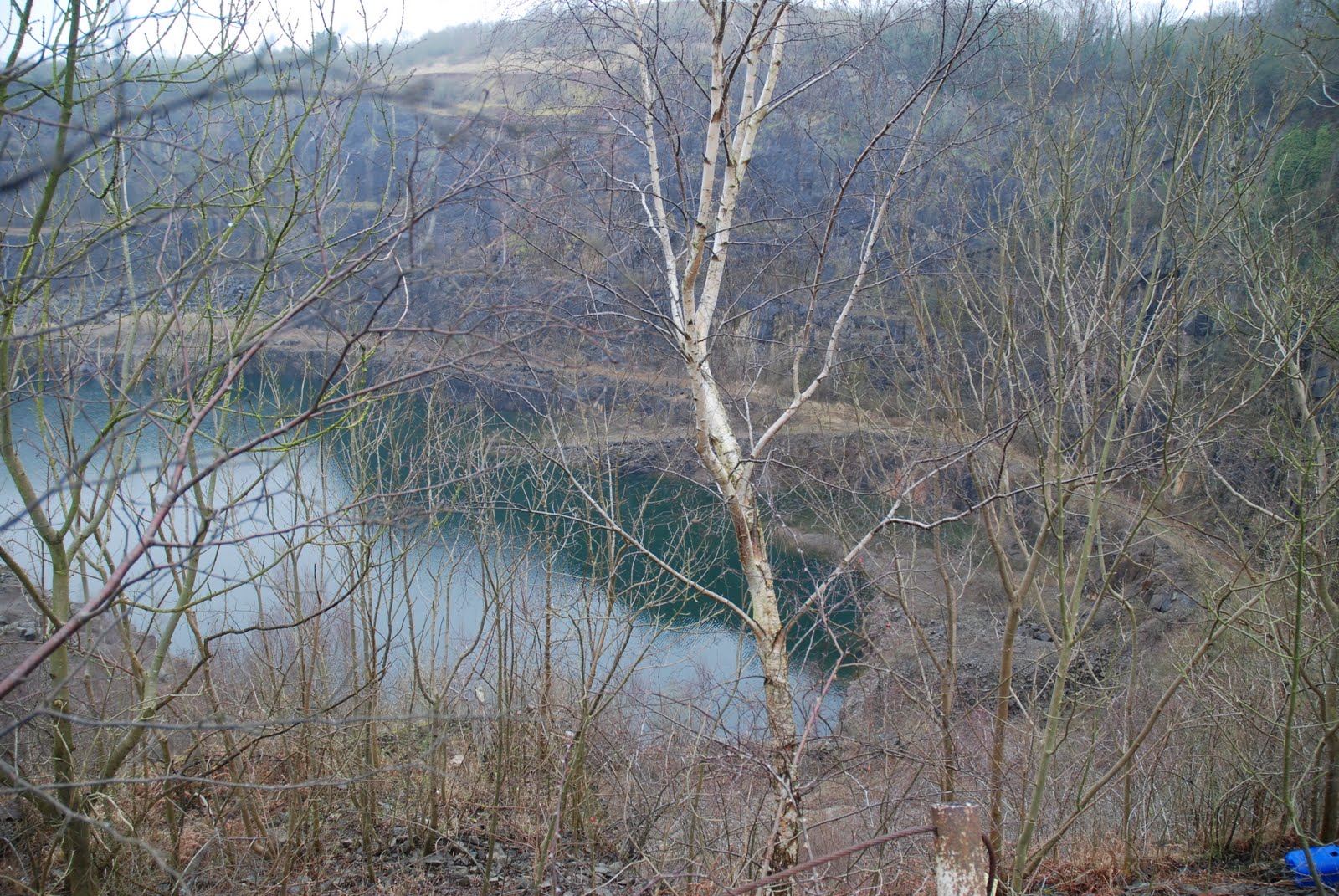
There are numerous old quarries, often flooded, that have a wonderfully impressive grandeur.
I also drove down to visit one of the china clay pits. The site manager was extremely helpful and I spent a few hours being shown around + collecting various samples. The most interesting are those that are not commercially viable, such as the mica deposits. There are a few grades of china clay excavated here, each washed down into the valley individually.
The clay filled water runs along the valley floor till it is sucked up into the separating equipment at one end. The sky was pure blue and I was surrounded by acres of white sand. Almost like my dream holiday destination. Give me a kiln, a wheel and a small country pub and I'd be happy!
Sunday, 13 March 2011
Busy busy busy
It's been rather a long time between posts but I've been really rather busy.
This board of tests represents a weeks work! There's a couple of biaxials and some simple fusibility tests. The rest are progressive lineblends, building on previous results and generally incorperating more materials ie becoming more complex. I've spent much time massaging my wrists after serious mortar and pestle work. To releive the monotony I've been calcining, hammering and crushing other collected samples and testing various time lengths of ball milling , wet and dry, to get as 120 mesh sample. OK so it's not going to thrill all of you reading this and you'll probably have to imagine my serene faced satisfaction when holding a jar full of 120 mesh Mountsorrel granodiorite, but oh boy! what a feeling!
Ive also spent time at the geology department of Cambridge University running loss on ignition tests on samples of clays I've collected. I've also prepared samples for the more interesting sounding Laser Particle Size Analysis, and been preparing for my next trip. Off to Devon this coming week.
This board of tests represents a weeks work! There's a couple of biaxials and some simple fusibility tests. The rest are progressive lineblends, building on previous results and generally incorperating more materials ie becoming more complex. I've spent much time massaging my wrists after serious mortar and pestle work. To releive the monotony I've been calcining, hammering and crushing other collected samples and testing various time lengths of ball milling , wet and dry, to get as 120 mesh sample. OK so it's not going to thrill all of you reading this and you'll probably have to imagine my serene faced satisfaction when holding a jar full of 120 mesh Mountsorrel granodiorite, but oh boy! what a feeling!
Ive also spent time at the geology department of Cambridge University running loss on ignition tests on samples of clays I've collected. I've also prepared samples for the more interesting sounding Laser Particle Size Analysis, and been preparing for my next trip. Off to Devon this coming week.
Thursday, 24 February 2011
Back in Leicestershire
The best and most unanticipated thing about doing this project is visiting places, that I wouldn't usually see or spend much time in, in quite an intimate way - and meeting some great people, who are a wealth of information and actually interested in this rather weird thing that I am doing.
For the last couple of day's I was back in Leicestershire collecting more samples from previous test sites and from new places. The first image is Groby Quarry, which hasn't been mined for 15 years, just biding its time really until it is worth quarrying again.
Today the weather was far better and my clothes started to dry out from yesterday. I was shown around Beacon Hill by one of the rangers, who was extremely generous with his time and knowledge. It's the second highest point in the area and represents an exposure of the oldest rocks in England. It is a volcanic tuff, which was deposited in the pre-cambrian era.
Then it was a short drive to Mountsorrel, where there is a huge quarry, mining the slightly younger granodiorite. The woods around the quarry are full of these spectacular boulders.
It was also a chance to stay with Ben Brierley and hit the dazzling streets of Loughborough for a fantastic curry. Check out his blog http://ben-brierley.blogspot.com/
For the last couple of day's I was back in Leicestershire collecting more samples from previous test sites and from new places. The first image is Groby Quarry, which hasn't been mined for 15 years, just biding its time really until it is worth quarrying again.
Today the weather was far better and my clothes started to dry out from yesterday. I was shown around Beacon Hill by one of the rangers, who was extremely generous with his time and knowledge. It's the second highest point in the area and represents an exposure of the oldest rocks in England. It is a volcanic tuff, which was deposited in the pre-cambrian era.
Then it was a short drive to Mountsorrel, where there is a huge quarry, mining the slightly younger granodiorite. The woods around the quarry are full of these spectacular boulders.
It was also a chance to stay with Ben Brierley and hit the dazzling streets of Loughborough for a fantastic curry. Check out his blog http://ben-brierley.blogspot.com/
Tuesday, 15 February 2011
First results
So, this is what happens when you heat up parts of Leicestershire! Various igneous rocks here next to preliminary melt and glaze tests. Yes there's a lot of brown, but I think it's going to be a dark area. High in iron. But there is significant variation in the samples that I've collected.
The next image shows a biaxial from one of the darker rocks, varying quartz and dolomitic limestone.
The following images are lineblends from two of the areas I've collected from. Darker results from Leicestershire of course, but starting to get some subtler results including, would you beleive it, a blue(ish) celadon and a lovely deep green.
The clay tests didn't fare quite so well - I might photograph them once I've scraped/ground them off my poor kiln shelves!
Friday, 11 February 2011
Too much beer and then Ebay
Well at midnight after a few too many Fullers ESB's anything looks like a bargain! This little beauty caught my fancy. A cast iron corn mill. If only I had a tractor to run it from.....but I've cleaned it up and it is all set to become a fantastically useful tool in my future career as a rock crusher. I've tried it out manually(!) with some calcined granite and it's pretty good.
I haven't blogged for a while and it's because I've been busy creating a map of the Alps on my hands entirely out of blisters with a mortar and pestle making up series of lineblends and biaxials from the samples I got in Leicestershire.
Who would've thought that so much work could be reduced to such a small photo? Everything is loaded up into the test kiln and tommorow I'm doing a couple of consecutive firings - test reduction to cone 9 and a biscuit in the big kiln. I hope I don't get confused between the two!
Tuesday, 1 February 2011
Government plans to sell off our forests
Please go to
http://www.38degrees.org.uk/page/s/save-our-forests#petition
and protest about the government's plans to sell off our own country, the few woodlands we have left in England.
http://www.38degrees.org.uk/page/s/save-our-forests#petition
and protest about the government's plans to sell off our own country, the few woodlands we have left in England.
Subscribe to:
Posts (Atom)